
Playbook entry
Jun 22, 2026 on deck
Low Code
Arcade
Arcade is not low-code in the traditional sense—but it ships agents and an MCP server that may change the narrative-cost math. Still on deck until I prove one flow beats ~$42/mo Growth and the agent path actually drops my explanation tax.
- Documentation
- Product Marketing
- Demos
- MCP
Show the flow, not the lecture—interactive demos that turn product actions into the simplest narrative a customer can follow.
Composite
4 /20
- Vibe Ready 1/5
- Time to Wow 1/5
- Ease of Use 1/5
- Depth of Value 1/5
Supplemental
- MCP Stack Fit 2/5
How the rubric reads here
Vibe Ready
1/5Would a non-technical founder reach for it with confidence?
Zero vibe-codable from Cursor. You cannot prompt your way to an Arcade—you capture flows in their Chrome extension, desktop app, or uploaded media, then edit in their studio. My MCP stack cannot talk to it today. That is the point of this entry: awesome tool, terrible fit on this axis.
Time to Wow
1/5How fast from signup to something you can show someone?
Not measured in "npm install and ship." Capture, branch, voiceover, embed—Arcade's own pitch is ~6 minutes to a demo, but that assumes you already know what story you are telling. For my roadmap, wow comes after I have flows worth externalizing, not on day one of a greenfield repo.
Ease of Use
1/5Can a PM own it day-to-day without an engineer on call?
Easy for a PM or marketer who lives in demos—not for wiring into an agent bench. I love it; I still have to figure out how it sits next to Astro docs, Engine MCP, and the rest of the fractional stack without becoming another silo.
Depth of Value
1/5Does it grow with you—or hit a hard ceiling in six months?
Depth here is narrative depth, not stack depth. Once embedded, an Arcade can replace repeated "let me walk you through this" calls—but it does not grow your codebase, your CRM, or your MCP surface. High customer impact; low traditional stack lock-in.
MCP Stack Fit (supplemental)
2/5Can your agent bench read, write, or wire this tool—or is it human-native glue you integrate on purpose?
Reassessment in progress (Jun 2026). Arcade ships an MCP server on all plans—including Free—that connects agents to Brand Kits, URL sources, and AI video generation. That is not my Engine MCP bench, but it is not zero either. Current MCP limits: no interactive demo creation, no post-create video edit, AI credits for video. Score moves from 1→2 pending proof that agents reduce narrative labor enough to justify paid Growth—not because the connector exists on paper.
Founders note: This is not low-code in the traditional sense. It is super edgy. I throw it in the cookbook and the playbook anyway because I think it is highly impactful—and because honest scoring sometimes means a 4/20 composite with a tool you absolutely love. Update: they list Agents as a core feature now, and they ship an MCP server—so this entry is due for a tech reassessment, not a victory lap.
What Arcade is
Arcade turns your actual product into interactive demos, AI-generated videos, and on-brand visuals—captured from a browser extension, desktop app, or uploaded media, then edited with hotspots, branching, chapters, voiceovers, and personalization.
Their product menu now includes Agents—workflows powered inside Arcade—not just capture-and-edit. That matters for a cheap founder doing stack math: if agents actually shrink the cost of producing and maintaining narratives, Arcade graduates from “on deck” to paid stack. I have not proven that yet.
It is built for GTM storytelling: marketing embeds on the site, sales sends custom links, CS scales onboarding, enablement ships training without a video agency. Companies like Zapier, Sentry, and OpenAI show up on their customer wall—not because Arcade replaces your stack, but because showing beats telling when the product is hard to explain in prose.
Tech reassessment — agents and MCP
When I first wrote this entry, the honest read was: no Cursor vibe path, no MCP in my bench. That was incomplete.
Arcade publishes an MCP integration on Free, Growth, and Enterprise. Connect Claude (or another MCP client) to your Arcade workspace and you can drive Brand Kits, URL sources, and AI video generation through conversation—videos typically land in one to four minutes. Permissions are scoped (read vs write; delete not supported yet).
What MCP still cannot do (per their docs today):
- Create interactive demos through MCP
- Edit videos after creation
- Anything without burning AI credits on video/visual generation
So the reassessment is narrow but real: Arcade is not agent-native the way Cursor + Engine MCP are, but it is no longer “human-only glue.” If their Agents feature closes the loop—capture, narrate, refresh, branch without me on a call—the supplemental MCP Stack Fit score moves again. Today: 2/5, up from 1, with the write-up doing more work than the bar.
The cheap-founder pricing wall
I am a cheap founder. I notice when one stack component costs the equivalent of three.
Arcade’s Growth plan lists at $50/mo per seat, often shown at ~$42.50/mo with discount messaging—I have seen promos closer to ~$38 depending on timing and startup programs. Free exists: one published demo, one published video, unlimited views, AI voiceovers—enough to prove one flow, not enough to run a documentation layer.
My stack mental model: Supabase, Inngest, Postmark—each justified as infrastructure with a free or low entry and a clear job. ~$42–50/mo for Arcade Growth is not irrational for GTM teams; for a solo fractional founder it is one line item eating three. I understand the price. I cannot casually add it until agents + MCP prove they decrease narrative cost more than the subscription increases burn.
Paid stack criteria (for me): one high-value flow live on Free → agent/MCP path refreshes copy or video without a re-record → Growth pays for itself in avoided intro calls. Until then: on deck, reassessing.
Why it is in the playbook anyway
The four-dimension rubric was built for tools a non-technical founder can reach for with Cursor, MCP, and a repo. Arcade still fails most of that test:
- You cannot vibe-code a full interactive demo from Cursor—you capture, then edit in their studio.
- Engine MCP does not replace Arcade’s MCP; different connector, different job.
- What I can do is convert actions and flows inside my products into narratives—and now maybe let their agents and MCP shoulder part of that labor.
That is a different job than Supabase or Inngest. It is still a job I want out of my calendar—if the math works.
The documentation exit
I want to get out of the days where I am telling people how to do something. I want to show them why things work the way they work—and leave them with something they can replay without booking me.
Arcade is the leading candidate for that layer as my roadmap moves forward over the next couple of months: externalize the documentation, embed it on stephansmith.me and product surfaces, and stop re-explaining the same flow on every intro call.
Stage: on deck. Judgment is clear; payment is not—reassess agents + MCP on Free, then decide if Growth is three stack components worth of narrative leverage.
MCP stack fit — supplemental score
The core composite is still 4/20—floor on vibe-ready, time-to-wow, ease, and traditional stack depth.
MCP Stack Fit is the supplemental axis for tools like this: Does it belong in an MCP-first bench, or is it human-native glue you integrate on purpose? Arcade is 2/5 after reassessment—not because I am sold, but because an MCP server exists on every plan with real (limited) write paths. The impact score—customer clarity, time back—can still dwarf the bars. Read the write-up, not just the composite.
At a glance
- What it is: Capture → interactive demo / video / visual → embed, link, or branch—product storytelling without a design agency.
- Best for: Onboarding flows, feature tours, pre-sales demos, “why this works” narratives when prose and Loom threads are not enough.
- Not a fit: Paying Growth before one Free-tier flow proves narrative ROI; treating Arcade MCP as a substitute for capture studio (it is not—no demo creation via MCP today).
- Pairs with: Astro for embedding on static surfaces, Cursor for building what you capture (different layer), your public site and newsletter CTAs once demos are live.
When to reach for it
Reach for Arcade when you have repeated yourself three times on the same flow and you know the next customer will ask again. If you are still changing the UI every week, wait. If the flow is stable and the explanation is expensive, capture it once and let Arcade carry the narrative.
Watchouts
MCP cannot create interactive demos or edit videos after the fact—plan capture in the extension, automation for Brand Kits and video only. AI credits cap video/visual generation; running dry fails requests until upgrade or top-up. Growth at ~$42–50/seat (plus $150/mo additional seats on Growth) is GTM pricing, not cheap-founder pricing—do not let “agents” marketing bypass the spreadsheet. Stale hotspots after a UI redesign erode trust faster than no demo; agents do not remove that maintenance unless they actually do. Startup discounts exist—worth asking on Intercom before you mentally anchor at list price.
Roadmap: Tech reassessment on agents + MCP (Free tier) → one published flow → Growth only if narrative cost drops enough to justify ~three infrastructure line items.
Related playbook entries
- Astro — where embedded demos and playbook content live on the public site.
- Cursor — builds the product you capture; does not replace Arcade’s capture studio.
- Postmark — another layer where “show in the email” beats “paragraph of instructions.”
Why there are no vibe-coding prompts
There is no CookbookPromptCard block here on purpose. You do not scaffold Arcade from a prompt—you record the truth, then edit the story. When I have a capture workflow worth documenting, this section gets a “how I record Fractional.tools flows” addendum—not generic agent prompts.
Tech Stack Clarity Check (15 min) — Book a slot if you want a second pair of eyes on where interactive demos fit next to MCP, Astro, and customer onboarding.
Addendum — the arcade button
The mark is an isometric push button—dark base, white cap, ARCADE in heavy caps. It looks like the thing you mash when you want the story to start. Irrational confidence I respect: your product is not a PDF.
The homepage leads with the same bet: paste a URL, pick demo or video, and let AI build the story from your actual product—not a slide deck.
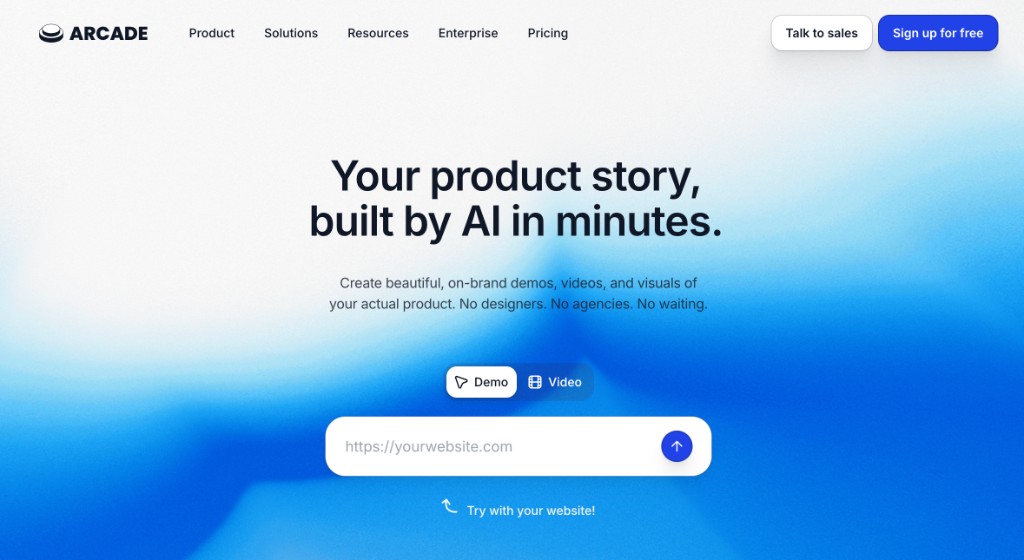
Arcade homepage — show the flow, not the lecture. On deck in my stack; terrible composite, awesome solution.
Related notes that mention this tool
Tag:
product:arcade
No cross-references yet. Add placement: ['product:arcade'] to any post frontmatter.