
Playbook entry
Jun 22, 2026 live
Low Code
Fly.io
Fly.io is deceptively simple bare-bones hosting: hobby tier for pre-prod, ~$6 servers, multi-region in config, and SOC-friendly auditability—without the Sherman-tank AWS tax.
- Hosting
- Workers
Docker edge without the Docker PhD—a secret weapon most devs walk past.
How the rubric reads here
Vibe Ready
5/5Would a non-technical founder reach for it with confidence?
It's Docker and it makes it possible for you to push an application to a Docker Edge server without ever knowing anything about Docker. They will figure out what basic Docker you need, but then the actual Docker instance file is stored in your application. So they've made it super simple to have a server that you configure through code that can deploy to a server.
Time to Wow
5/5How fast from signup to something you can show someone?
Your hobby instances are free. And other than a fast restart time, you can get your application started when you're in pre-production mode at zero cost. When you scale up, a server costs six bucks and I have been hard pressed to pound the hell out of it CPU wise and make it slower. I discovered this in a demo in Ireland at the Node.js conference in 2022. It is deceptively simple. Absolutely deceptively simple.
Ease of Use
2/5Can a PM own it day-to-day without an engineer on call?
This is not a solution that immediately rolls itself out. This is a present that takes a little time to unwrap, but its value comes in its simplicity, and simplicity isn't always easy to see and understand. Fly does not look like the solution the developer would find on their own—and it's not the logical solution that most developers go to.
Depth of Value
2/5Does it grow with you—or hit a hard ceiling in six months?
This is a simple stack. This is not AWS. You won't get all of the bells and whistles, but you will get the power of AWS, which is the ability to spin up servers in a cybersecurity auditable format. Bare bones—but you can scale up from two servers to 50 servers in under five minutes.
Founders note: Fly was a secret weapon. I discovered this in a demo in Ireland at the Node.js conference in 2022.
What Fly is
It is deceptively simple. Absolutely deceptively simple. It’s Docker and it makes it possible for you to push an application to a Docker Edge server without ever knowing anything about Docker. They have made it super simple. They will figure out what basic Docker you need, but then the actual Docker instance file is stored in your application. So they’ve made it super simple to have a server that you configure through code that can deploy to a server. And you get all the benefits of a server without all of the need to understand AWS and its complexity or even the architecture of Heroku. This is bare bones.
But there are two or three major features that are valuable. First, your hobby instances are free. And other than a fast restart time, you can get your application started when you’re in pre-production mode at zero cost. When you scale up, a server costs six bucks and I have been hard pressed to pound the hell out of it CPU wise and make it slower. They support organization level Redis and Postgres clusters that are built directly into the same edge instance as your server. And then if you need to go multi-region, where you need to be in California, Chicago, and Virginia, it’s as simple as telling Fly that you want your server available in different regions. You can even let it spin down two of your servers and only keep one up. This is a great way to have the most minimal stack that scales when you need it but scales down when you don’t.
Why devs skip it
Fly does not look like the solution the developer would find on their own. Most developers tend towards stacks like Google Cloud or AWS. Fly looks too small, too simple, and too edgy to be the right solution. But its simplicity is what gives it the power.
Sherman tank vs spitball fight
One of the challenges that I’ve noticed is that AWS is like bringing a Sherman tank to a spitball fight. You don’t need it and it comes with a whole bunch of architecture. Like it’s IAM for user management. It’s designed for a team of two or three hundred in a large enterprise organization. But most small companies do not have enough developers to use IAM properly. So as a result, they use it improperly.
So when you start working with Fly, you realize you have an architecture that’s far simpler. You can separate your production from your staging as simply as having two separate org accounts. You can stay on the hobby as long as you need. You can keep your staging on hobby. You can keep yourself from getting the AWS bloat that comes with the token, with the free credits you get from AWS. And you can keep your burn rate in your servers to under 20 bucks a month with very, very little effort. But it’s not the logical solution that most developers go to.
SOC2 and the regret of big cloud
When a founder goes and does its cybersecurity scan, the SOC 1, SOC 2, they’re going to start noticing that there are a whole bunch of issues built into using large cloud solutions that now impact their ability to document their SDLC, their software development lifecycle, and to secure it. So their dev team will essentially run rampant over cybersecurity practices in a large AWS instance or in Google Cloud because they have too many tools and the tools are fit for large teams, not for small teams. So a founder is going to regret jumping over Fly when they realize the cost for actually documenting all the evidence needed for SOC2.
Co-founder and investor pitch
When you’re pitching this to a co-founder, they’re probably not going to understand why you’re passing up on $30,000 to $200,000 worth of AWS credits. They’re not going to understand it. But what you need to tell them is that simplicity allows us to stay small and move fast. And simplicity allows us to scale up and look like the big boys without taking on all the risk and all of the architecture that comes with a much larger platform that you may grow into, but you’re not there now.
Investors want to know that when they dump gasoline into the engine that you can go faster. And what you can tell them if you use Fly is that you are essentially using a managed stack in which your ability to shoot yourself in the foot for SOC is very low. Your auditability is super high. And you can scale up from two servers to 50 servers in under five minutes. But you get the value of edge servers, servers that are sitting out in the cloud close to your customers, and you can do it without all the subject matter expertise that comes with a systems or an operation manager.
How we use it on Fractional.tools
Go read Fractional.tools and see how we used it there—the tech stack map is the short version.
On Fractional.tools, the API is built and run in fly.io, which has edge servers. We love this because it gives us the ability to contain everything in code, all documentation. It gives us the ability to run very lightweight, single-use, but high-scalable multi-region edge servers. The front end is React and it’s stored and it’s running on Cloudflare. And then the database, which is Postgres and Auth, it’s handled by Supabase.
The API did not start on Fly—it started on Render until an account termination right before a founder demo sent us elsewhere. See the Render playbook addendum for that story; Fly is the production home now.
At the heart of Fractional Tools, it’s a back-end service that plugs into calendars like Outlook and Google. The API runs on Fly and it uses auth keys to connect. So when a user comes in, they give us credentials, we ask for them, we set up a relationship, and we manage the webhooks or watcher events that are coming out of Google.
At a glance
- What it is: Docker edge hosting—you configure through code, deploy to servers close to customers, without becoming a Docker or AWS person.
- Best for: Pre-prod on hobby tier, staging on hobby, prod under ~$20/mo burn, multi-region when you need California, Chicago, and Virginia, and stacks you need to audit for SOC.
- Not a fit: When you need all the bells and whistles of AWS—or when your team will default to credits and enterprise architecture you cannot document or secure.
When to reach for it
Reach for Fly when you want the most minimal stack that scales when you need it but scales down when you don’t. If your co-founder is staring at $30,000 to $200,000 in AWS credits, tell them simplicity allows us to stay small and move fast—and simplicity allows us to scale up and look like the big boys without taking on all the risk and all of the architecture that comes with a much larger platform that you may grow into, but you’re not there now.
Read the stack first: Fractional.tools tech stack — see Fly next to Cloudflare and Supabase in production.
Also in this lane: Surge for static hot deploy · Render for git-backed static + Services · Cloudflare for DNS, Pages, and Workers (Express stays on Fly).
Need a walkthrough? Book an intro call — I can walk you through why bigger is not better, more is not better.
Addendum — illustration at the ground level
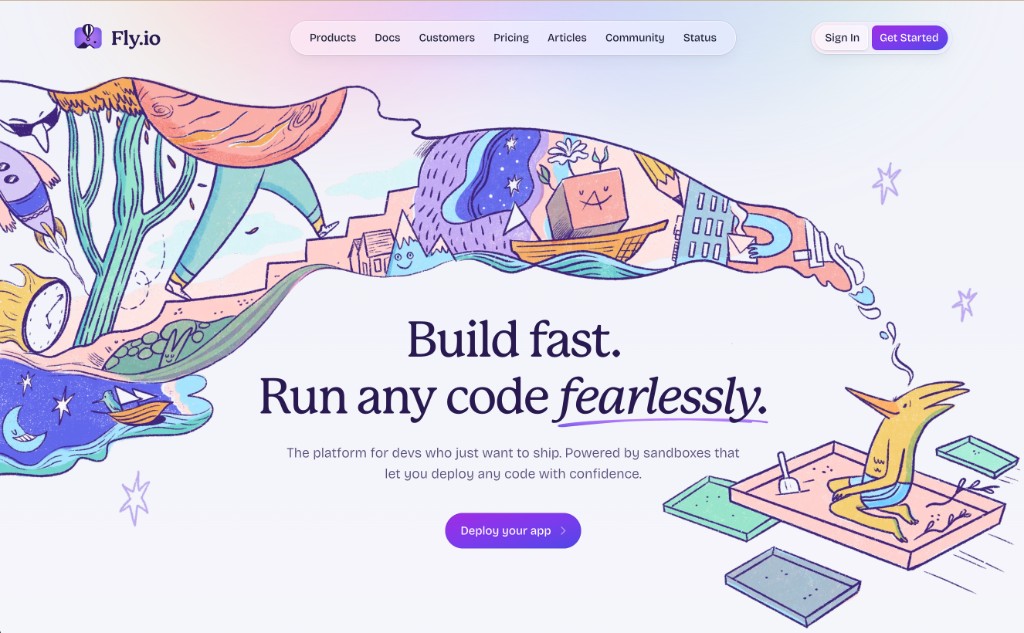
One of the things to note is that this company actually hired a real illustrator to do their work and I connected with her on LinkedIn and her work is astounding and it is absolutely beautiful to see true illustrations embedded into a product at the ground level. Love the fact that their founders and their team valued the bespoke work of an illustrator.

Related notes that mention this tool
Tag:
product:fly